The Notary Coach Blog
For Notary Entrepreneurs
Love Yourself Enough to Do the Work

Ever had a morning like this?
You set the alarm the night before with intention & purpose. You were going to get up early and finally work on the thing that matters to you:
-
The business you keep saying you're going to build;
-
The book you’re going to write;
-
The certification you’re going to acquire;
-
The exit plan from the job that's draining the life out of you.
The alarm goes off, and you actually get up. And somewhere between the coffee and your desk, your phone lights up with somebody else's priorities.
Or the laundry catches your eye.
Or you open an app for “just a second” and that second turns into a 45-minute rabbit hole.
By the time you look up, the window of time you set aside for the important work is gone.
“Don’t worry,” you tell yourself, you'll get to it tomorrow.
But then, later that night, you go to bed with a subtle, familiar ache, a reminder that you’ve once again broken another promise to yourself.
I want to talk about that ache, be...
I Have a Library Full of Courses I've Never Opened

I'm going to admit something that undercuts most of what I do for a living.
I'm a course collector. Probably one of the worst offenders you'll find. I see a program that looks interesting, I buy it, and it goes into a library I rarely actually touch. Some of them I bought years ago.
They sit there looking impressive, and they've changed exactly nothing about how I work because I've either never opened them, skimmed, them, or took them and never applied the knowledge in them.
I bring that up because I hear the same pattern from notaries constantly. Six certifications, eight certifications, a row of logos under an email signature, and still competing for $75 signings.
The certifications aren't the problem, and I want to be careful here, because this is where people stop reading and start angry-typing in the comments section.
Certifications open doors. They give you a starting framework. They're a sign that you took the profession seriously enough to spend money on it.
But let's be ...
The Year I Earned Nearly $365,000 and ALMOST Couldn't Pay My Rent

I know many people think it's gauche to talk money, or worse yet, money problems, but the lessons I learned through this experience, and who I became out the other side, is a story you might just need to hear.
Especially if you've ever struggled financially.
I want to tell you about the hardest financial year of my life.
And believe it or not, it wasn't one of the years where I was flat broke. In retrospect, those years were actually pretty easy to navigate because there was nothing to manage.
No, I want to tell you about the year I came within a thousand dollars of hitting a goal I'd been chasing since my early twenties: To earn an average of $1,000 for every single day of the year.
And I damn-near hit it! That year, my revenue as a loan signing agent came in at $364,000 (But I didn't even know that until April the following year at tax time).
And get this, I almost couldn't pay my rent in November.
I'd never worked so hard and felt so broke. I was driving 400 miles a day, chu...
Stop Swimming With Sharks! Why Most Notaries Fight in the Red Ocean, and How to Escape It

Blood in the water...
In business terms, that's called a Red Ocean, a phrase that comes from the book Blue Ocean Strategy by W. Chan Kim and Renée Mauborgne.
A Red Ocean is a crowded market where everyone offers the same thing, competition comes down to price, margins shrink, stress climbs, and people start complaining about oversaturation.
Sound familiar?
The Red Ocean in the Notary Industry
For notaries, the Red Ocean is obvious.
It's the signing companies, the national platforms, and the low-fee order aggregators, where the whole game is being first to click and competing on speed, price, and, if we're being straight about it, desperation.
It's the low-hanging fruit, and it feels easy.
There's no prospecting, no sales, no relationship building, and no positioning. You just wait for the pings & dings from orders that are broadcast to hundreds, if not thousands, of other notaries to come in.
And because it feels easy, everyone piles in, and when everyone piles in, the market ...
Rethinking the Notary: The Book I Wrote for Your Dream Clients, Not for You
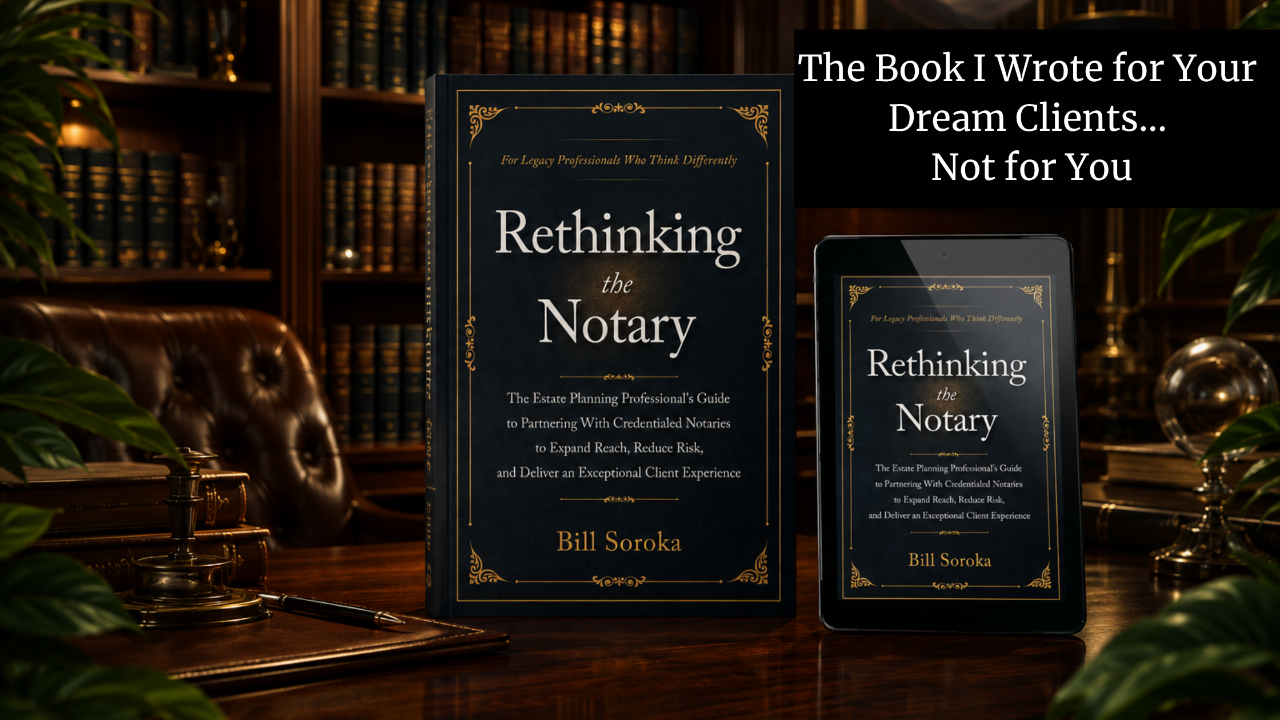
I've written a lot of resources over the years aimed directly at notaries, and this one is different, so stick with me here.
My newest book, Rethinking the Notary, isn't written to you. It's written to the estate planning professionals you want to work with, the attorneys and paralegals and legal document preparers and trust companies who are sitting on more business than they can handle and don't yet realize you're the answer.
And that's exactly why I'm so excited about it for you!
What the Book Actually Does
The full title is Rethinking the Notary: The Estate Planning Professional's Guide to Partnering With Credentialed Notaries to Expand Reach, Reduce Risk, and Deliver an Exceptional Client Experience, and every word of that subtitle is doing real work.
The book makes a case that most estate planning professionals have never seriously considered, that the credentialed mobile notary is the most underutilized asset in their entire practice.
It walks them through the bottleneck t...
The Zoom Trance: How "Just One More Training Call" Slowly Kills Your Productivity

I have caught some flack for bringing this up before, but we have to talk about it anyway.
It's the endless parade of trainings and Zoom calls filling up our calendars. There are so many of them out there, and I know I am responsible for a good chunk of them myself. Whether I am the one hosting or somebody else is, here is what I need you to understand:
Not every call and every opportunity is meant for you.
-
Some of them are sales webinars dressed up as education, and half the time they are selling us a product we already own.
-
Some are actual training calls where you walk away with something specific you can use.
-
Some are Q&A sessions that speak directly to your specialty and to exactly where your business is right now.
-
And then there is a whole category of calls that hand us random knowledge, interesting on its own maybe, but not actionable and not relevant to what we actually need at this point in our journey.
That last category is the one I want us to look ...
Become Irreplaceable
What's that even mean?
Irreplaceable: Something or someone too special, rare, or valuable to be replaced with a duplicate. It indicates a lack of a substitute.
Bearing that in mind, let's talk about why you keep having to find your next client, why that can end up feeling like a grind after awhile.
You do great work at the signing, you collect your fee, and then... you start over. Next week, next search, next stranger. The relationship ends the moment the stamp comes down.
There's a different way to do this.
It starts with a word most notaries use wrong: Partner.
Here's the shift:
Instead of being a vendor that estate planning professionals hire and forget, you become a partner in their growth. You become someone who sends them business AND receives it.
A two-way street.
Not just a taker of appointments, but a giver of appointments too.
Think about what that does to a relationship. When you're the notary who refers families to the right attorney, the right document preparer, ...
The Fourth Seat at the Table
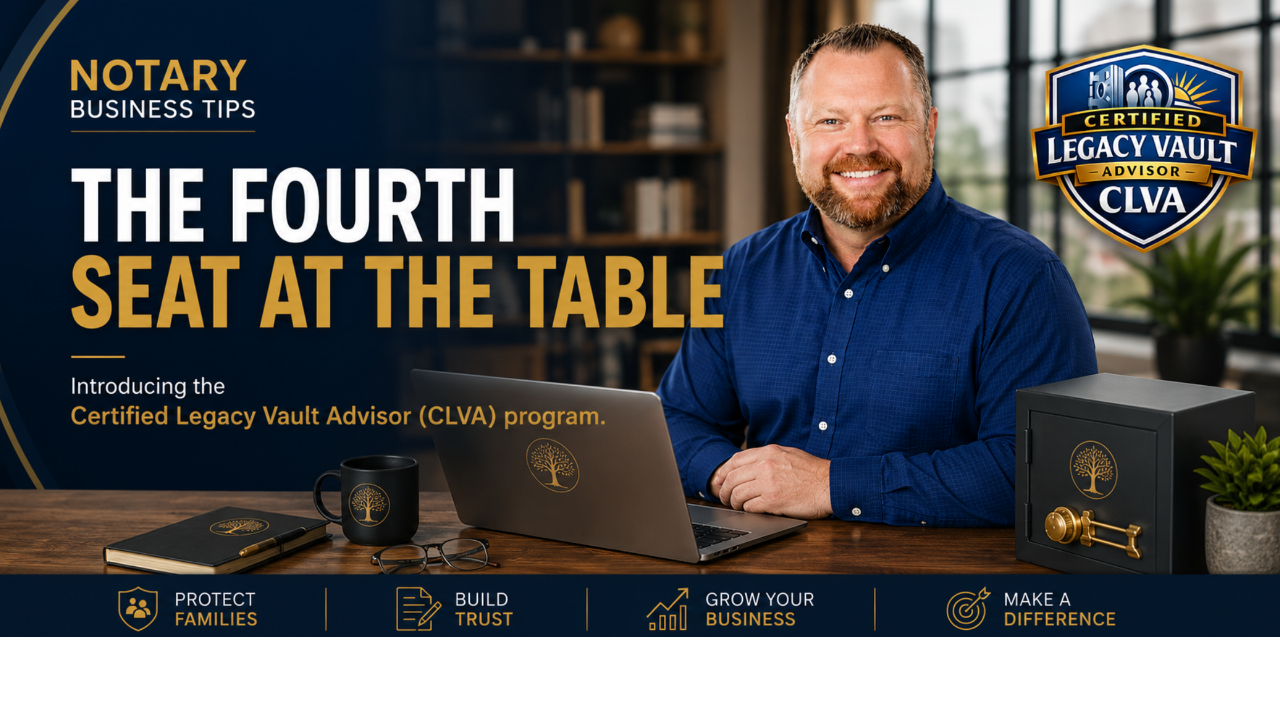
There's an old idea in the business and networking world called the Triangle of Trust. These are the three most trusted advisors a person can have: their attorney, their financial advisor, and their tax professional.
Those three get the spotlight. They get the referrals. They get treated like the inner circle of a family's most important decisions. And rightfully so, I have people for each of these in my life too.
I've spent years thinking about that triangle, and I've come to believe it's missing a corner, because here's what few people realize:
Those three professionals spend enormous energy just trying to get their foot in the door of their prospective clients. They work hard to prove and differentiate themselves, they market, they chase the appointments.
Meanwhile, there's a professional who gets invited in, who sits down at the kitchen table during the biggest moments of a family's life, who's already trusted, already vetted, already there.
The notary.
Think about it, not...
Peer Networking Events are The Backbone to Your Notary Business
Shared experiences like networking events, workshops, conferences, trainings, even online meetups, have the potential to shape the future of your business in ways you can’t predict.
It only takes one conversation, one idea, or one relationship to change everything.
Sometimes it’s the content you learn about.
Sometimes it’s the energy in the room.
And sometimes, it’s the person sitting next to you.
But what makes peer networking events so powerful for notaries goes deeper than just inspiration.
It’s about building something most notaries never intentionally create:
A true professional ecosystem.
Your Business Ecosystem
This is a business that can feel isolating. You’re often working alone, figuring things out in real time, solving problems on the fly.
Peer relationships change that.
They give you:
-
Support from people who understand exactly what you’re navigating
-
Perspective from others trying new strategies in different markets
-
Momentum from being around people
...
You Don’t Need Another Strategy, You Need to Finally Pick One
If you’ve been in this business for a while and still haven’t seen the traction you expected, there’s a good chance it’s not because you haven’t learned enough.
Most notaries I talk to have read the articles, watched the videos, maybe even invested in a few courses with certifications. They’re not lacking information. What they’re missing is a clear decision about which path they’re actually going to commit to.
There was a time when most of the calls I did were traditional coaching calls. This is what most of our coaching calls would focus on:
We’d get on the phone, talk through your situation, unpack your goals, work through what might be holding you back, and explore different directions you could take.
And those conversations felt productive. You’d leave with a clearer understanding of what you wanted and what might be possible.
But over time, I started to notice a pattern..
It usually took multiple calls… multiple conversations… to turn that clarity into anything actionable.
...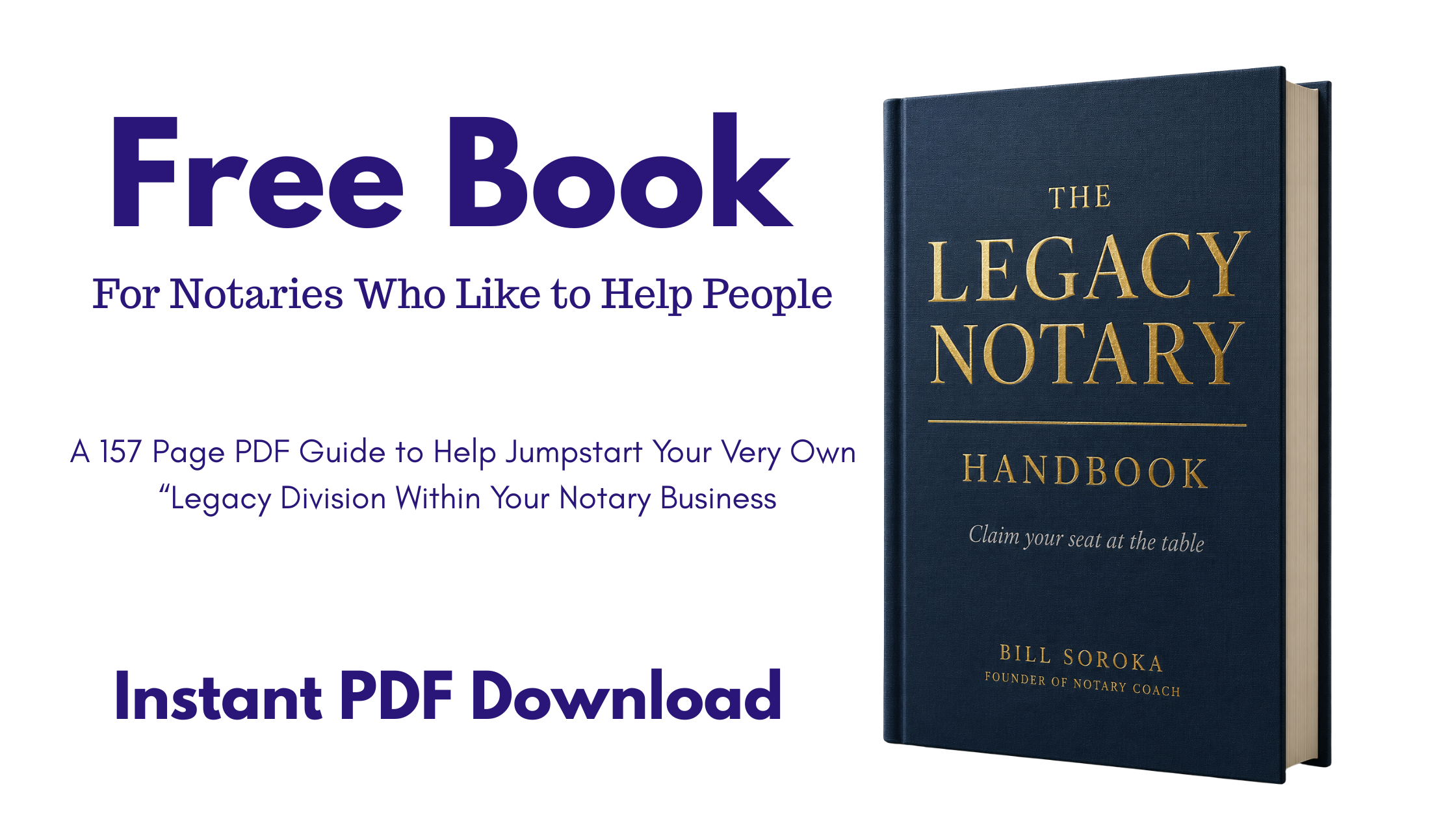
Free Download: The Legacy Notary Handbook (157 Pages)
You're already the trusted person in the room during the biggest decisions of a family's life. You're just not getting paid like it... yet. This free 157-page guide shows you how to step fully into that role, help more families, and build something that actually lasts. Instant download, zero cost.

Make Progress Every Day With Support!
I built a community on the Skool platform for ANY notary who would like to make massive progress on your goals and make it your best year ever! This community includes video lessons and challenges, PLUS live teaching and training direct from me. This is a GOAL oriented community and we'll check-in on revenue goals weekly, quarterly, and annually. More Clients, Income, & Confidence!

Get More Attorney Clients!
This "new" specialty is the future for mobile and remote notaries! I went all-in on living trust presentations for estate planning professionals, and I created this FREE REPORT that details my strategy and the Top 25 Lessons I learned Marketing to Estate Planning Attorneys.
You won't believe this!

Free Report: How to Make $2,000 a Month as a Loan Signing Agent
No matter what is happening in the world, someone, somewhere, is buying, selling, or refinancing real estate. Every single one of those transactions requires a notary public. With brief additional training, and a willingness to meet clients at a convenient time and location, you can build the ultimate side hustle or business.
Flexible Schedule. Unlimited Income. Legitimate Business.
Become a Mobile Notary and Loan Signing Agent.
Recent Posts