Minimum Standards Are Failing the Notary Profession

There’s a reality about the notary profession that most people outside of it never see....
A huge percentage of notarial work happens behind the scenes, privately, and without any real oversight.
And here's the thing, there's an estimated one billion notarized documents every year.
No public database of notarizations.
No centralized quality control.
No routine audit of whether the work was done correctly.
And, frankly, most of the time, that’s fine…
Until it isn’t.
And here's part of the problem:
In many states, the threshold to become a notary is exceptionally low.
A short application.
A modest fee.
Maybe a basic exam (Sometimes not even that).
And once commissioned, a notary can practice for years, even decades, without anyone ever reviewing their work.
That means a notary can be doing things incorrectly or non-compliantly for a very long time…
And no one ever knows.
It’s not a problem…
Until it’s a problem.
Until a document is contested in court.
Until a property is stolen through deed fraud.
Until a family dispute explodes years after an estate document was signed.
Until forgery is discovered long after the ink has dried.
By then, the damage is already done.
This is one of the unfortunate realities of our profession: errors often surface years later, when fixing them is expensive, painful, or impossible.
There are only a couple of areas in the notary world where meaningful quality control happens early.
Loan signings are one, because title, escrow, and mortgage companies check (what they know to look for) before funding or shortly afterward. Errors hopefully get caught quickly because money is on the line.
Apostilles are another.
In apostille work, the competent authority is literally double-checking the notary’s work before authenticating a document for international use.
And here’s a statistic that still surprises people:
Over half of apostille rejections are due to notarial error.
Fifty percent!
That number tells us something important…
It’s not that notaries don’t care or don’t want to do things correctly, it’s that many were never properly trained, tested, or held to a consistent standard in the first place.
And outside of loan signings and apostilles, there is often no early warning system at all.
Which brings us to the bigger issue.
The notary public is entrusted with identity verification, willingness, awareness, and capacity. We are the frontline defense against identity theft, property fraud, elder financial abuse, and forged transactions.
This work matters.
Yet, as a profession, we’ve largely relied on minimum state requirements and hoped for the best.
If the government isn’t going to regulate and standardize at a national level to match the responsibility we bear (and honestly, I’m not sure that’s even the right solution-who wants that?), then we have a responsibility to do something ourselves.
We have to self-regulate.
We have to raise the bar.
We have to honor the office we hold.
That’s why the American Guild of Notaries Public (AGNP) matters.
AGNP exists to do what the current system does not.
It creates a voluntary national credentialing standard based on demonstrated knowledge, experience, ethics, and accountability, not just possession of a commission.
And, it gives employers, attorneys, agencies, and the public a way to recognize notaries who have chosen to go above and beyond than the minimum.
It acknowledges that a commission alone tells you very little about a notary’s competence.
AGNP doesn’t exist to replace state authority, it exists to supplement it with something that’s been missing for decades: demonstrable knowledge and how to apply it.
And that wisdom matters.
Because right now, from the outside, all notaries look the same:
A stamp.
A title.
A signature.
AGNP changes that by saying:
-
Some notaries are willing to be tested.
-
Some are willing to be evaluated.
-
Some are willing to be held to higher standards, consistently.
This isn’t about ego or status, it’s about trust.
-
Trust in documents that may not be reviewed for years.
-
Trust in transactions that shape lives and families.
-
Trust in a profession that plays a critical role in the lives of everyone in this country.
We are often the last human checkpoint before a document becomes legally meaningful.
That’s not a small thing.
The launch of AGNP is a signal that the notary profession is ready to take itself seriously in a new way. That we’re done pretending that minimum requirements are enough simply because “that’s how it’s always been.”
This is about protecting the public.
It’s about protecting notaries who do things the right way.
And it’s about building credibility that lasts beyond a single transaction.
For those of us who care deeply about this work, this moment feels overdue, and necessary.
This is not about creating an elite club, it’s about creating clarity.
When standards are visible, everyone wins.
The public is safer.
Good notaries stand out.
And the profession finally has a way to say, with confidence:
This work matters.
And how it’s done matters even more.
Minimum standards may have been enough to get us here, but they’re no longer enough to take us forward.
The risks are real, the stakes are high, and the consequences of getting it wrong often surface long after the opportunity to fix them has passed.
If we want the notary profession to be trusted, respected, and relied upon in a world of rising fraud and increasingly complex transactions, we have to be willing to hold ourselves to a higher standard.
That’s what the American Guild of Notaries Public represents. and why this moment matters, not just for today’s notaries, but for the future of the office we’re sworn to protect.
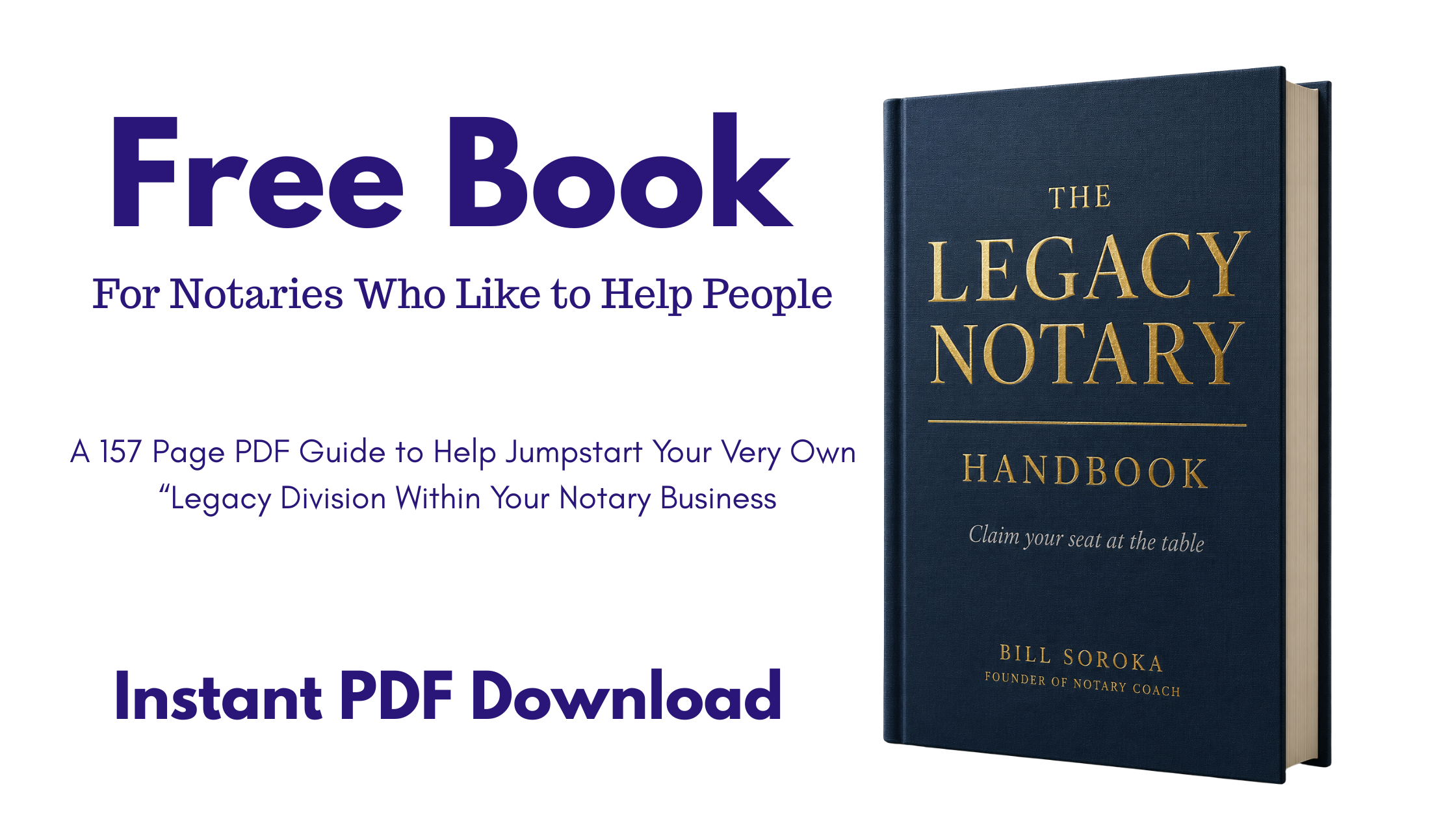
Free Download: The Legacy Notary Handbook (157 Pages)
You're already the trusted person in the room during the biggest decisions of a family's life. You're just not getting paid like it... yet. This free 157-page guide shows you how to step fully into that role, help more families, and build something that actually lasts. Instant download, zero cost.

Make Progress Every Day With Support!
I built a community on the Skool platform for ANY notary who would like to make massive progress on your goals and make it your best year ever! This community includes video lessons and challenges, PLUS live teaching and training direct from me. This is a GOAL oriented community and we'll check-in on revenue goals weekly, quarterly, and annually. More Clients, Income, & Confidence!

Get More Attorney Clients!
This "new" specialty is the future for mobile and remote notaries! I went all-in on living trust presentations for estate planning professionals, and I created this FREE REPORT that details my strategy and the Top 25 Lessons I learned Marketing to Estate Planning Attorneys.
You won't believe this!

Free Report: How to Make $2,000 a Month as a Loan Signing Agent
No matter what is happening in the world, someone, somewhere, is buying, selling, or refinancing real estate. Every single one of those transactions requires a notary public. With brief additional training, and a willingness to meet clients at a convenient time and location, you can build the ultimate side hustle or business.
Flexible Schedule. Unlimited Income. Legitimate Business.
Become a Mobile Notary and Loan Signing Agent.
Recent Posts