A Book Review of From Trust to Transfer and What It Reveals About the Future of Notary Work

Every notary eventually asks the same question, whether they say it out loud or not:
Is this really it?
For many, that question shows up after the excitement of loan signings wears off. For others, it appears when the work starts to feel rushed, transactional, or disconnected from the reason they became a notary in the first place.
That’s why I want to talk about a book that says something important about where this profession is heading.
I recently read From Trust to Transfer by Dean Eason-Williams, and I gave it five stars because it’s practical, honest, and grounded in real work at real signing tables.
It’s a book about doing the work well.
A Different Kind of Notary Appointment
Estate planning appointments are not like loan signings. They move at a different pace. They carry a different emotional weight. And they demand something different from the notary in the room.
In From Trust to Transfer, Dean doesn’t romanticize this work, but he doesn’t minimize it either. He makes it clear that estate signings are not just about executing documents. They’re about presence, professionalism, and restraint.
When families sit down to sign wills, trusts, powers of attorney, and advance directives, they’re not thinking about paperwork…
They’re thinking about children…
About aging parents…
About illness…
About what happens if something goes wrong.
The notary becomes part of that moment.
That’s why this book resonates. It acknowledges that estate signings require notaries to bring both competence and composure to the table.
Not “Just the Notary”
One of the most valuable threads running through the book is Dean’s refusal to accept the phrase “I’m just the notary.”
He reminds readers that notaries are commissioned public officials. When we walk into someone’s home or an attorney’s office, we represent more than ourselves. We represent process, order, and accuracy at a moment when mistakes can echo years into the future.
This matters deeply in estate planning work.
A missed initial…
An incorrectly placed seal…
A poorly handled question that crosses into unauthorized practice of law….
These aren’t small errors in this context. They can become real problems for families long after the signing is over.
Dean addresses this head-on by focusing on:
-
Understanding estate documents at a high level
-
Ethical redirection when signers ask legal questions
-
Staying confidently within the notary’s lane without sounding evasive or unsure
The book doesn’t try to turn notaries into attorneys. Instead, it shows how knowledge and preparation allow notaries to reduce friction, not create it.
Why Attorneys Care (More Than Notaries Realize)
One of the underappreciated themes in From Trust to Transfer is how much this work impacts attorneys.
Estate planning attorneys don’t want more phone calls from the signing table. They don’t want to fix avoidable errors. And they don’t want to wonder whether the person representing them understands the gravity of the work.
Notaries who can conduct estate signing ceremonies with clarity and confidence quickly stand out.
Dean’s approach, both in the book and in his work, positions notaries as trusted extensions of the attorney, not just rubber-stamp vendors.
That distinction is the difference between:
-
One-off assignments
-
And long-term professional relationships
It’s also where the real opportunity lies.
The Opportunity Beneath the Book
While From Trust to Transfer is first and foremost a practical guide, it also hints at something bigger.
Estate planning appointments are not seasonal, and are not interest rate-dependent, and they don’t disappear when the market shifts.
People plan their estates every day.
Families need documents executed properly whether the economy is booming or tightening.
That consistency creates an opportunity for notaries who are willing to specialize, slow down, and raise their standards.
This isn’t about doing more appointments. It’s about doing better ones.
Higher trust.
Higher value.
Higher expectations.
And yes, often higher compensation.
A Quiet Standard-Setter
What I respect most about Dean’s book is that it doesn’t shout and yell, or preach a bunch of fluff. It’s actually a pretty quick read.
It doesn’t promise instant success.
It doesn’t sell a dream.
It doesn’t pretend estate work is easy.
Instead, it sets a standard.
If you’re a notary who:
-
Wants to be taken seriously
-
Wants work that feels meaningful
-
Wants to build a business that isn’t built on churn and burnout
This book is worth your time.
It shows you what’s possible when you approach the work with intention.
The notary profession needs more examples of what good looks like.
From Trust to Transfer contributes to that conversation in a meaningful way, and in doing so, it points toward a future where notaries are known not just for availability, but for excellence.
That’s a future worth paying attention to.
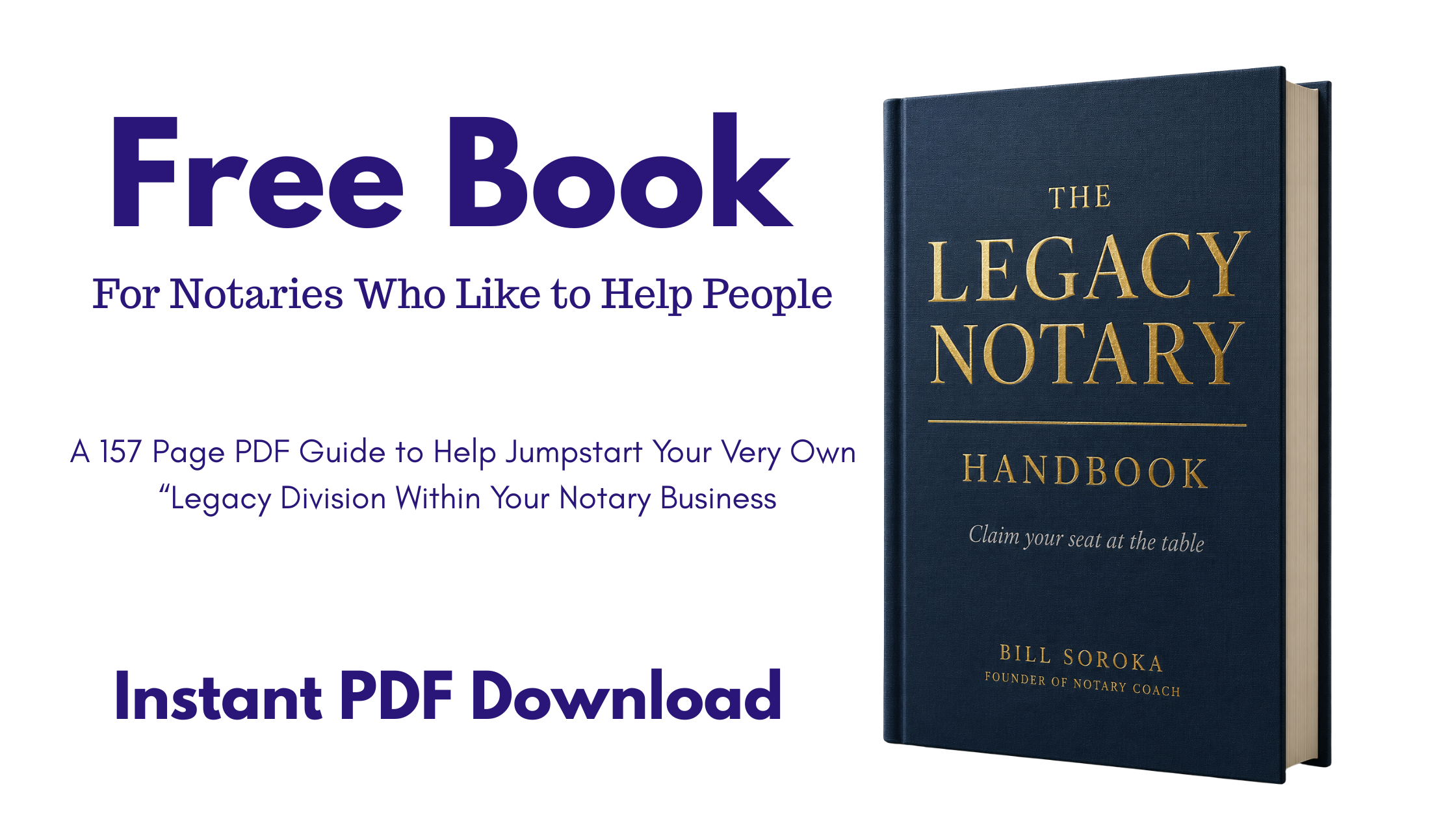
Free Download: The Legacy Notary Handbook (157 Pages)
You're already the trusted person in the room during the biggest decisions of a family's life. You're just not getting paid like it... yet. This free 157-page guide shows you how to step fully into that role, help more families, and build something that actually lasts. Instant download, zero cost.

Make Progress Every Day With Support!
I built a community on the Skool platform for ANY notary who would like to make massive progress on your goals and make it your best year ever! This community includes video lessons and challenges, PLUS live teaching and training direct from me. This is a GOAL oriented community and we'll check-in on revenue goals weekly, quarterly, and annually. More Clients, Income, & Confidence!

Get More Attorney Clients!
This "new" specialty is the future for mobile and remote notaries! I went all-in on living trust presentations for estate planning professionals, and I created this FREE REPORT that details my strategy and the Top 25 Lessons I learned Marketing to Estate Planning Attorneys.
You won't believe this!

Free Report: How to Make $2,000 a Month as a Loan Signing Agent
No matter what is happening in the world, someone, somewhere, is buying, selling, or refinancing real estate. Every single one of those transactions requires a notary public. With brief additional training, and a willingness to meet clients at a convenient time and location, you can build the ultimate side hustle or business.
Flexible Schedule. Unlimited Income. Legitimate Business.
Become a Mobile Notary and Loan Signing Agent.
Recent Posts