I Have a Library Full of Courses I've Never Opened

I'm going to admit something that undercuts most of what I do for a living.
I'm a course collector. Probably one of the worst offenders you'll find. I see a program that looks interesting, I buy it, and it goes into a library I rarely actually touch. Some of them I bought years ago.
They sit there looking impressive, and they've changed exactly nothing about how I work because I've either never opened them, skimmed, them, or took them and never applied the knowledge in them.
I bring that up because I hear the same pattern from notaries constantly. Six certifications, eight certifications, a row of logos under an email signature, and still competing for $75 signings.
The certifications aren't the problem, and I want to be careful here, because this is where people stop reading and start angry-typing in the comments section.
Certifications open doors. They give you a starting framework. They're a sign that you took the profession seriously enough to spend money on it.
But let's be precise about what a certification actually proves. It proves you could afford the program, and it proves you passed a test. That's it.
It doesn't prove you know what to do when the signer's ID expired last month, or when the daughter is standing beside them answering on their behalf, or when the notarial certificate calls for an act you're not authroized to do in your state.
The Gap Nobody Was Measuring
I've sat on both sides of this. I've hired notaries for millions of dollars in signings over the years, and I work with hiring parties now, like title companies, law firms, estate planning attorneys, who are all trying to solve one problem:
How do I find someone who actually knows what they're doing?
Here's what that looks like from their chair:
They open a directory. They see two hundred notaries. Every one of them lists the same certification. Some of those notaries are extraordinary, some are dangerous, and most are somewhere in the middle, growing into it.
The certification tells the hiring party nothing about which is which. Especially in the loan signing realm, everyone has the exact same certification.
That's a structural failure in how our profession represents itself to the people who pay us.
I've watched attorneys give up and use their bank's notary. I've watched title companies default to whoever answers the phone first. They didn't stop valuing expertise, in fact, they crave it, but they just had no mechanism to identify it.
What Lori Taught Me About The Difference
When I first talked with Lori Hamm about credentialing, she gave me a distinction I've used probably fifty times since.
A certificate says: I learned something.
A credential says: I demonstrated I can apply it.
Lori spent two decades as Montana's Notary Administrator for the Secretary of State's office. She was the person on the other end of the line when a notary froze mid-appointment and needed an answer in ninety seconds. She'll tell you she came into that job not knowing how to spell "notary," and she'll also tell you that after twenty years of doing it eight hours a day, she still learns something new.
That combination of humility and depth is why I trust what she's built with the American Guild of Notaries Public (AGNP).
One thing she said has stayed with me...
Some of the best notaries she's ever encountered are terrible at tests. They suffer real test anxiety. If you put a multiple-choice form in front of them, they fall apart. But, on the other side, put them in a room with a nervous ninety-year-old and a complicated power of attorney and they're brilliant. They read the situation, they know their statutes, they find the lawful path forward.
A test can't see that person. It never could.
Finding A Way To Yes
Most notaries think mastery means knowing what you're not allowed to do. Learn the prohibitions, memorize the penalties, say no when in doubt.
I'd argue the opposite. The reason to know your state's notarial acts inside & out, every one of them, including the ones you've never performed, is so you can find a lawful way to serve the person in front of you.
Say somebody calls with a request. The instinct is to ask whether you're allowed to do that. The better question is whether this is a legitimate need, and how your state's law lets you meet it.
A notary who only knows basic jurats and acknowledgments in loan signings will turn away work they were fully authorized to perform. But a notary who knows their statutes and notarial acts will find the path forward. One of them is building a business, and the other is an order taker.
Lori framed this as the notary's obligation to legally accommodate the request. I'd add the entrepreneur's version, which is that this is also how you get paid.
Why I Went All In
I've spent a long time in this industry watching organizations promise standards and deliver logos. So I didn't take my partnership with the American Guild of Notaries Public lightly, and I didn't join because I liked the mission statement.
I joined because Lori built the thing the industry has been craving for years without knowing how to construct it.
The AGNP evaluation isn't a test, per se. It's an assessment of the whole professional notary.
There's a commission verification. Confirmation of insurance. Ensuring a background check is in place. Evaluation of your education history. Even reference letters from people who've actually worked with you.
And then there's a set of scenarios calibrated to your specific state's laws, moving from simple real world situations into gray areas where there's no clean answer and the only thing being measured is your judgment.
An dthen this is evaluated by humans, not some machine.
And another big deal with AGNP is that the credential can be revoked if a notary fails to meet the standards throughout the years, which include: Six hours of approved education a year, renewed membership, maintained insurance, adherence to a code of ethics you sign under penalty of perjury.
Nobody in this industry has ever taken back a certificate. That's precisely why a certificate can't carry the weight we keep asking it to carry.
The Directory
AGNP also built a public directory of credentialed notaries.
I've routed my estate planning partners to it. It's in my email campaigns. It's in the Legacy Vault materials. I highlighted it in Rethinking the Notary because I couldn't write a book about where this profession is headed and leave out the solution to the problem that's been strangling us.
An attorney who's never met a notary in her life can go to that directory and know that whoever she hires has been evaluated on their state's laws by a human being who read their answers.
I can't overstate what that does for a hiring party. It removes the risk from the decision, and when you remove risk from a decision, price stops being the deciding factor.
What This Changes On Monday
I coach a lot of notaries. The credentialed ones in my High Performance Notary community started doing something I didn't expect.
They stopped defending their rates.
The conversation used to go: "Well, my fee is $XYZ because of travel and printing and the time involved." Explaining. Justifying. Hoping.
Now it goes: "I'm a credentialed notary. If you want this handled correctly, I'm worth it."
One of them, Victor, has an attorney who sends him steady work. When her clients push back and say they'll find someone cheaper at the bank, she stops them. She tells them they're using Victor, no two ways about it. She defends his fee in rooms he's never walked into.
She's doing that because he's credentialed and qualified.
Where I Land
You're not going to certification your way to a business. I say that as somebody with a shelf full of unopened courses, so aim your objections at me and not at the concept.
Yes, take the classes. Read the books. Show up to the calls. Then close the laptop and go do the work, and pay attention while you're doing it, because that's the only place your "judgment-muscle" gets built. Lori's version of this is that some people learn by watching, some by listening, and some have to touch the electric fence. The fence teaches faster. It also hurts more.
But at some point, the market needs a way to see the difference between you and the person who bought the same certificate and never applied any of it.
That's what this credential is for.
Fraud is rising. Impersonation is rising. Remote notarization has thrown open the doors, and the people relying on us can't tell who's competent and who's winging it. The profession needed a standard that could be earned and lost.
We have one now.
Listen to my full conversation with Lori Hamm on The Sign & Thrive Podcast for Notaries: https://www.buzzsprout.com/1960402/episodes/19471341
Learn about credentialing: americannotaryguild.org
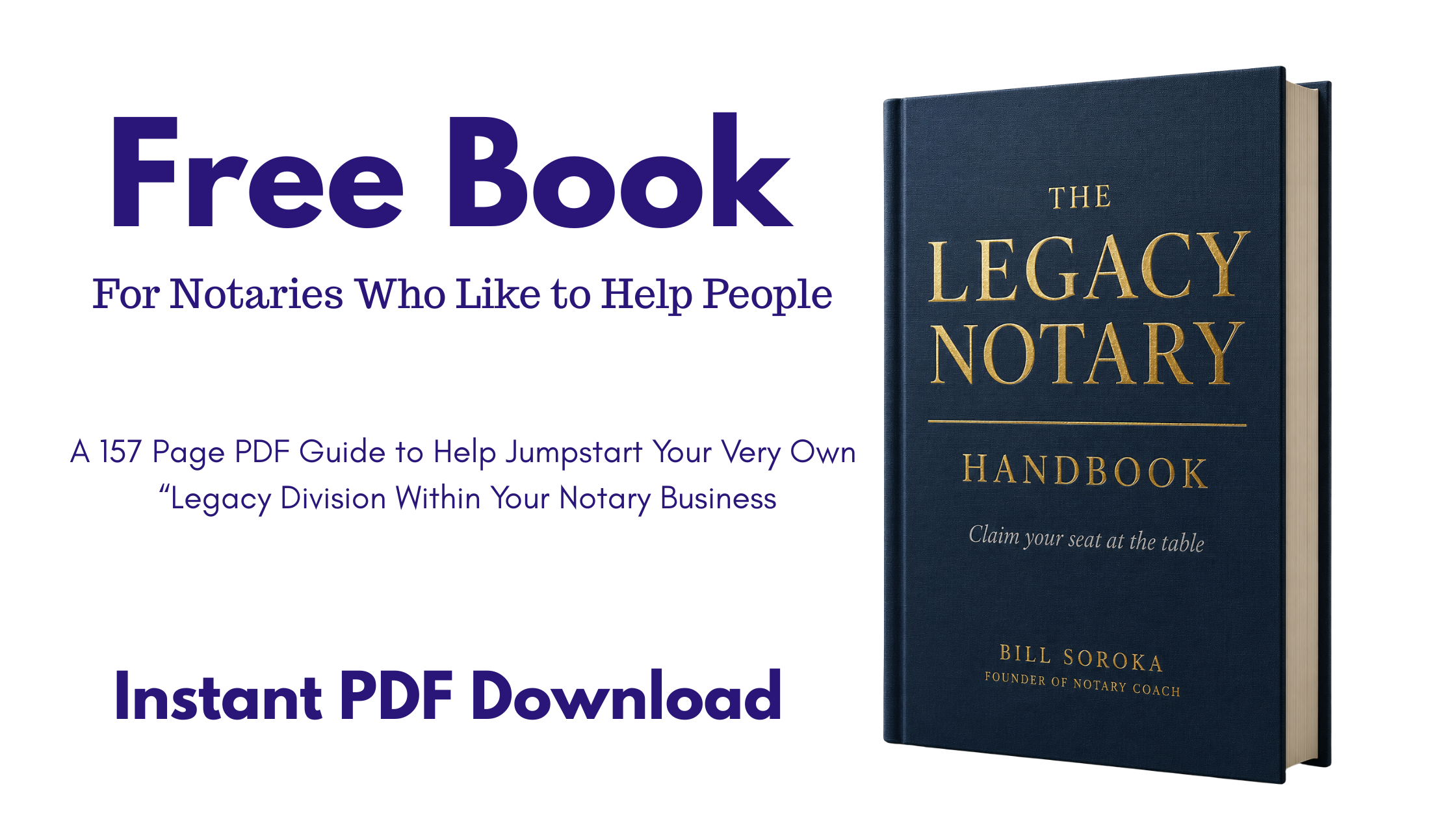
Free Download: The Legacy Notary Handbook (157 Pages)
You're already the trusted person in the room during the biggest decisions of a family's life. You're just not getting paid like it... yet. This free 157-page guide shows you how to step fully into that role, help more families, and build something that actually lasts. Instant download, zero cost.

Make Progress Every Day With Support!
I built a community on the Skool platform for ANY notary who would like to make massive progress on your goals and make it your best year ever! This community includes video lessons and challenges, PLUS live teaching and training direct from me. This is a GOAL oriented community and we'll check-in on revenue goals weekly, quarterly, and annually. More Clients, Income, & Confidence!

Get More Attorney Clients!
This "new" specialty is the future for mobile and remote notaries! I went all-in on living trust presentations for estate planning professionals, and I created this FREE REPORT that details my strategy and the Top 25 Lessons I learned Marketing to Estate Planning Attorneys.
You won't believe this!

Free Report: How to Make $2,000 a Month as a Loan Signing Agent
No matter what is happening in the world, someone, somewhere, is buying, selling, or refinancing real estate. Every single one of those transactions requires a notary public. With brief additional training, and a willingness to meet clients at a convenient time and location, you can build the ultimate side hustle or business.
Flexible Schedule. Unlimited Income. Legitimate Business.
Become a Mobile Notary and Loan Signing Agent.
Recent Posts